Earlier this month, at its Americas Meetup, IQGeo announced five products that extend the AI-Powered Network Intelligence Platform. The platform is built for telecom and utility operators to optimize and automate how they plan, design, build and operate their physical networks. Here is what was announced and when each product is available.
What New Products Were Announced at the 2026 IQGeo Americas Meetup
The platform delivers for telecom and utility operators for the first time an integrated Network Twin, Observability, Workflow, Field Execution and Governance capability in one foundation. Teams work from shared data and common services, and AI agents work alongside people, taking on routine tasks and passing work from one capability to the next. Operators can start with an accurate Network Twin (a digital model of the physical network and its records) and add agents one capability at a time.
| Product | Capability | What It Does | Availability |
| Visual Agent Studio 2.0 | Guided field work, right the first time | Builds and deploys Visual Agents in natural language, no code | Available now |
| Orchestration Manager | Workflow and orchestration | Coordinates tasks, work, agents and workflows internally and with third-party applications | Available now |
| Network 360 | Network observability | Tracks every change and reports KPIs for telecom networks | November 2026 |
| Adaptive Field | Agentic-driven field applications for any work | Builds and deploys field applications in natural language, no code | November 2026 |
| Agent Studio | Cross-platform agentic framework | Builds Network and Workflow Agents in natural language automating manual tasks and speeding workflows | Product preview |
The Five Products
Visual Agent Studio 2.0
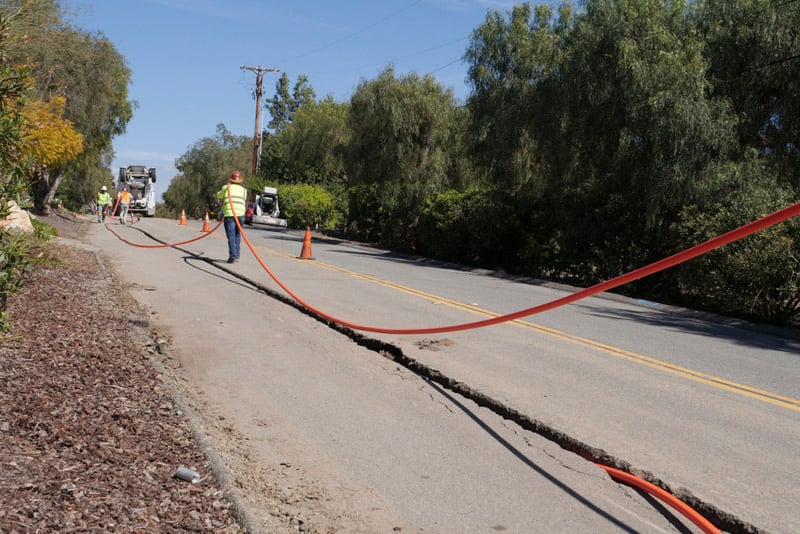
A Visual Agent uses AI to review photos from the field, such as a splice closure, pole or a cabinet installation. Every job is checked on site, and verified data is written to the network record. Visual Agent Studio 2.0 lets operators create new AI skills in natural language, with no code. They turn those skills into new Visual Agents and deploy them to the field in minutes. Operators can build from a library of pre-built agents for telecom and utility networks that deploy without disrupting operations, or build their own from photos and job descriptions. Visual Agent Studio 2.0 is available now and can run standalone or embeded in any existing FSM or field tool.
Orchestration Manager
Orchestration Manager is the automation layer of the IQGeo platform. Its visual flow editor lets operators build flows from triggers (a ticket, status or field change, or a schedule), conditions and actions: create tickets, send emails, call external systems through APIs or start an AI agent. By coordinating work across IQGeo and other systems, one saved inspection can open multiple follow-up tickets, a status change can query an ERP for budget approval and a new outage ticket can request dispatch and assign a technician. Orchestration Manager is available now.
Network 360
Network 360 optimizes network data to give telecom operators a complete view of network change over time. It captures every change from Network Manager in a purpose-built time-series database, so operators can analyze history and trends. That gives operators an audit trail of what changed, who changed it, when and why. It also automates KPI reporting on measures such as homes passed and rollout progress, with every number traced back to the network record. Network 360 is available from November 2026.
Adaptive Field
Adaptive Field is IQGeo’s mobile app for the people working on the network. Crews see their jobs alongside the assets they affect, work offline and capture complete, verified data through guided forms, photos and voice notes. Operators build it through an agentic interface: they describe the field process they need and the agent assembles the forms and ticket types, so a new process can reach a crew’s phone without a development project. What the crew reports can drive the next workflow step automatically. Visual AI photo checks are available where they help. Adaptive Field is available from November 2026.
Agent Studio
Agent Studio is the agentic framework for the whole IQGeo platform, designed to change how people work with it. Operators describe what they need in natural language and Agent Studio builds the agent, with no code. Network Agents reason over the Network Twin and Observability data, and Workflow Agents act across the lifecycle, taking on manual tasks and speeding up workflows. Operators start from an example in the gallery, describe the agent in the builder and run it under control in the manager. An agent can be started by Orchestration Manager, through an API or by a person, for example to turn a comment on a completed job into a ticket. Agent Studio is in preview now, with availability planned for Q1 2027.
Why This Matters to Network Operators
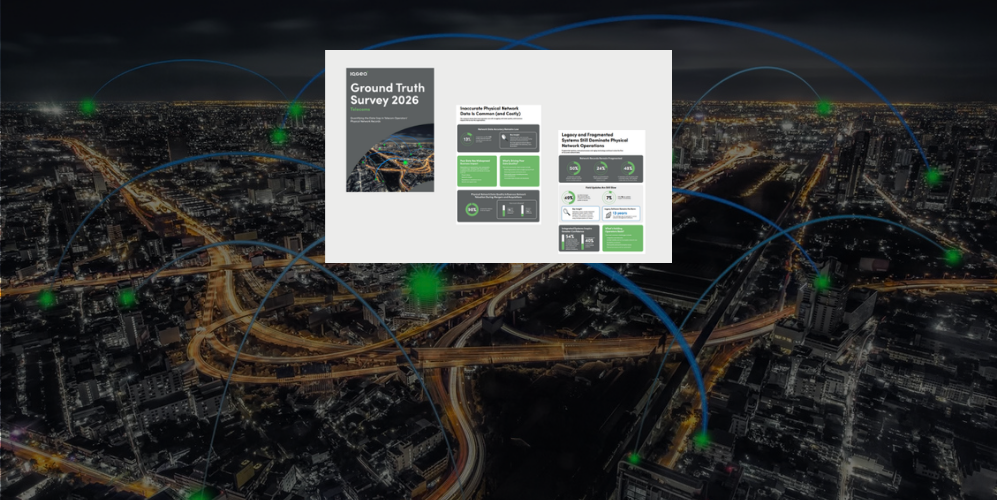
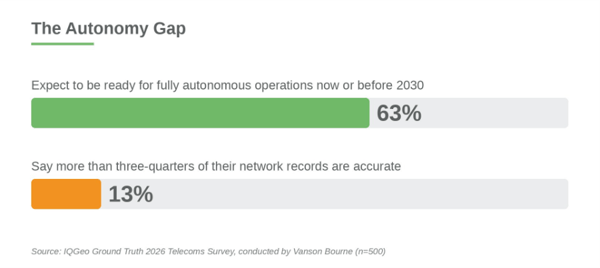
Operators are committed to autonomous networks, but the physical network inventory data they depend on isn't ready. In the Ground Truth 2026 survey of 500 telecom operators, 63% expect to be ready for fully autonomous operations now or before 2030, yet only 13% say more than three-quarters of their network records are accurate.
AI is only as good as the records it acts on. Each of these products builds on the accurate, governed record of the physical network, so people and agents act on data operators can trust.
Ground Truth Survey 2026 Insights Panel for Telecom
Senior telecom leaders from Brightspeed and Swisscom join IQGeo CTO David Cottingham to examine the survey findings and share their own experience of the challenges they reveal.