
Across telecom and utility networks, field operations generate huge volumes of data every day. Photos, videos and reports are created during construction, service activation, maintenance and inspections. Yet most of this data remains unstructured, difficult to verify at scale across operations and therefore underused. Consequently, operators have limited oversight of the work performed on their physical infrastructure, exposing them to compliance risk and operational inefficiencies.
This is where visual AI agents are transforming how operators manage their networks.
Visual AI enables operators to turn images into structured, actionable insights. With the introduction of visual AI agents, that capability is now moving further, enabling network teams to not only understand field data, but to operationalize it at scale across workflows, systems and decision-making processes.
This article looks at what visual AI agents are, how they work and why they are becoming essential for modern telecom and utility operations.
Visual AI Streamlines Quality Control and Network Asset Inventory Processes
Visual AI refers to the use of artificial intelligence to analyze images and videos captured in the field. Using computer vision, it allows systems to detect objects, identify patterns and interpret visual data automatically.
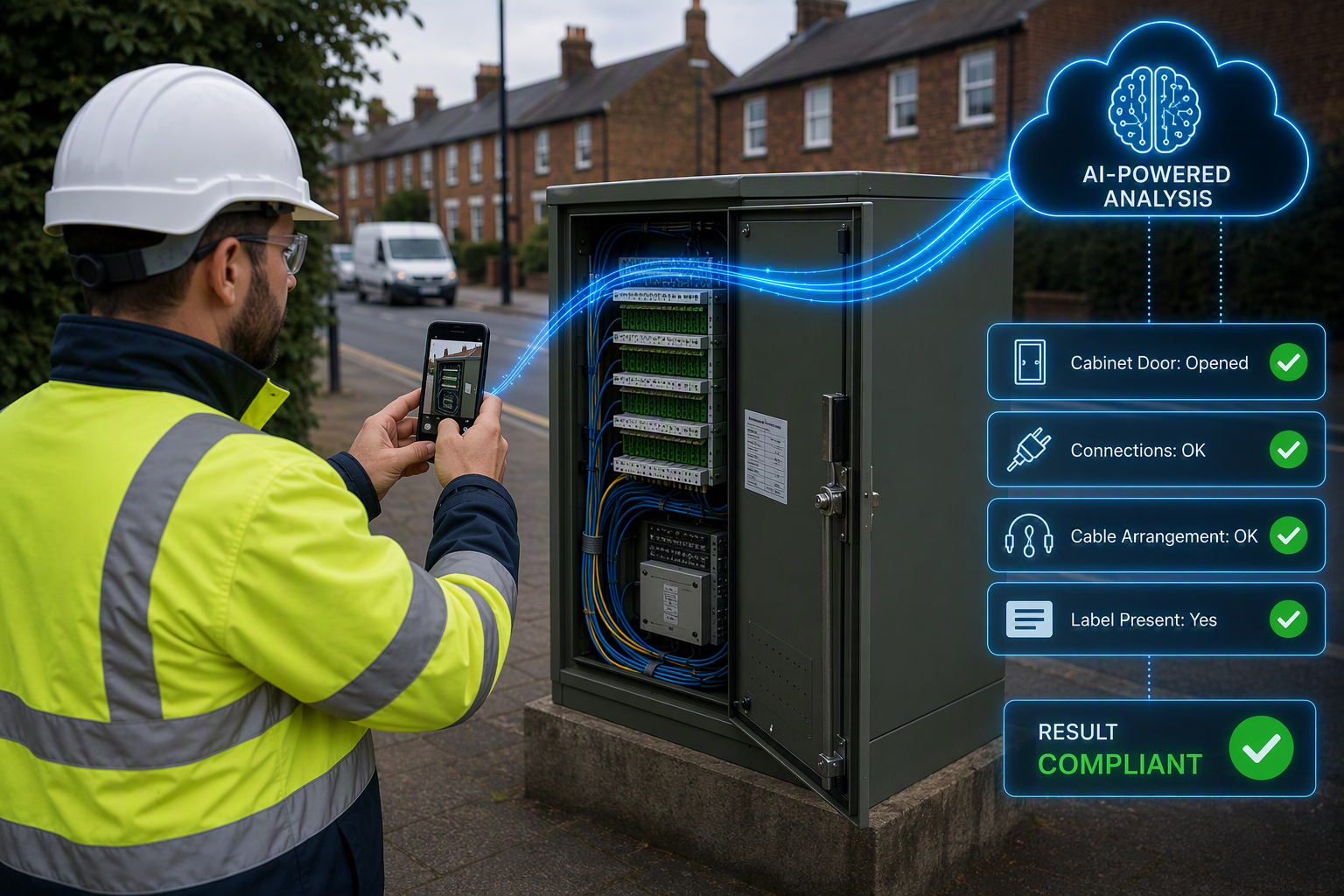
In telecom and utility environments, this means analyzing thousands photos captured by field crews to verify work completion and compliance with quality standards and inspect infrastructure. For example, visual AI can detect missing components in a smart meter installation, verify that fiber construction work meets specifications, identify defects or risks in infrastructure and extract structured data such as asset identifiers, labels, and installation attributes from images.
Computer vision systems can analyze large volumes of images quickly and extract detailed information that would otherwise require manual review.

Historically, telecom and utility operators have relied on manual quality assurance processes such as on-site audits or back-office photo reviews. Given the time and cost involved, most operators are only able to verify approximately 10-15% of field operations, creating uncertainty around the accuracy and completeness of the field data captured in their system. These quality assurance approaches are slow, costly, and difficult to scale. They often result in costly site revisits to correct errors or, worse, issues discovered at service activation that lead to delays, penalties or customer churn.
Visual AI addresses these challenges by enabling:
-
Real-time validation of field work
-
Consistent quality checks across all operations
-
Automated extraction of structured data from unstructured inputs
As a result, operators can ensure work is completed right the first time, reducing rework and improving overall efficiency.
Leading telecom and utility operators such as Swisscom and SFR have already embedded visual AI into their operations. Swisscom, for example, has used visual AI to scale quality control across 100% of operations cost-effectively and significantly increase first-time-right performance, while SFR has improved field compliance and contractor performance through real-time feedback and automated validation.
Visual AI Agents: From Photo Analysis to Operational Intelligence
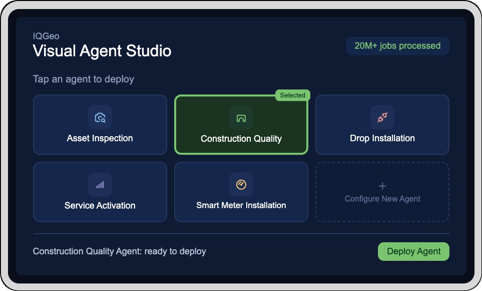
Visual AI helps telecom and utility operators see and validate what happens in the field. Visual AI agents extend these capabilities by adding reasoning and action on top of real-time, automated photo analysis. A visual AI agent is configurable through prompting. It combines visual inputs, such as a field photo, with user-defined instructions and leverages a multimodal large language model to analyze information, reason about the context and determine appropriate actions. It then returns structured outputs, such as pass or fail checks, numerical values, or standardized text, that can directly feed operational workflows. Visual AI agents operate as part of a continuous loop between field activity, AI analysis and operational systems:
-
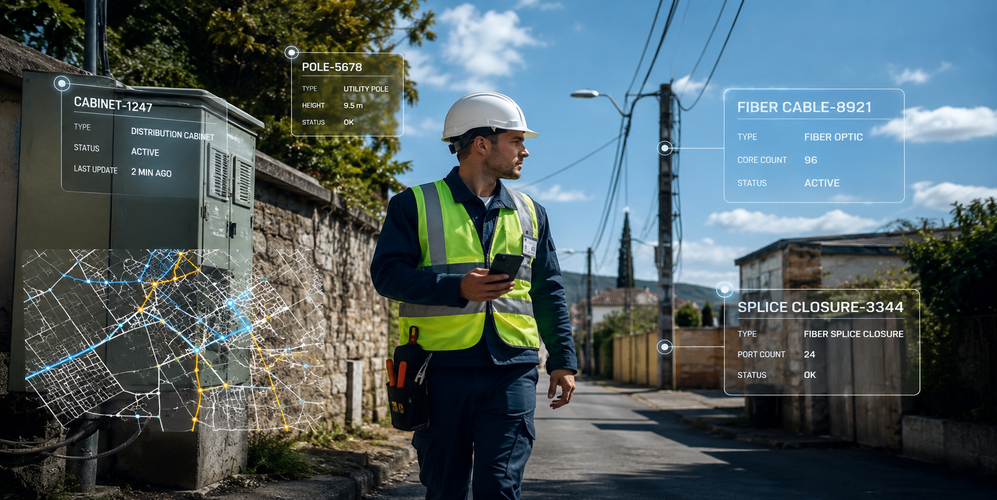
Field data capture: the process starts in the field, where technicians or engineers capture images as part of their workflow. They can be photos of fiber construction, of a smart meter installation or of a pole inspection. Visual AI agents link them to specific assets, work orders and locations.
-
Photo analysis: once captured, the images are analyzed in real time. Visual AI models automatically detect objects and components, assess quality and compliance and identify anomalies or defects at scale. The AI provides instant feedback to field workers, enabling corrections on site before work is completed.
-
Data structuring and enrichment: visual AI agents transform the output of image analysis into structured data. For instance, they can tag assets, extract key attributes and link findings to the network model. Instead of isolated images, telecom and utility operators now have searchable, standardized and structured information. This capability improves data quality and ensures consistency across operations.
-
Integrate with workflows: the real power of visual AI agents comes from integration with workflows. The structured data is connected to work orders, fed into operational systems and eventually used to drive decisions, such as automatically validating work for acceptance, triggering follow-up tasks if issues are detected or updating the network inventory. This integration turns visual insights into operational outcomes.
The objective of visual AI agents is therefore to interpret field evidence and structure the data in order to connect insights to telecom and utility asset system of record and operational actions. Instead of simply identifying a problem, visual AI agents help operationalize the response. This is a key shift from AI that sees to AI that supports execution.
Benefits of Visual AI Agents for Telecom and Utility Operators
The impact of visual AI agents for telecom and utility operators is both operational and strategic.
Operational benefits
-
Right-first-time execution: Errors are detected and corrected on-site in real time, reducing costly revisits.
-
Full-scale quality validation: Operators can validate 100% of field work rather than sampling a small percentage.
-
Automated workflows: Quality control, reporting, and validation processes become consistent and scalable.
-
Reliable field data: Photos and insights are transformed into structured, usable data integrated into decision-making systems.
Strategic benefits
Visual AI agents also play a critical role in the industry’s shift toward autonomous networks. By ensuring that field data accurately reflects real-world conditions, validating changes at the point of work, and feeding trusted data into network models, visual AI agents create a strong foundation for:
-
Intelligent decision-making
-
End-to-end workflow automation
-
Continuous operational optimization
These capabilities are essential to building self-updating, intelligent network systems that can operate with minimal manual intervention.
Benefits for IT and AI teams
For IT and AI teams, visual AI agents significantly simplify deployment by reducing reliance on complex, bespoke AI projects and by reducing the need for specialized data science resources. This democratizes access to advanced AI capabilities and allows organizations to scale visual AI initiatives more quickly and effectively.
The Path Forward: Visual AI for Telecom and Utility Operators
Telecom and utility operators are under increasing pressure to scale network deployment, improve quality, and reduce costs. At the same time, they must manage growing volumes of field data that are critical to network performance. Visual AI agents represent a major step forward.
By combining the analytical power of visual AI with workflow automation and operational intelligence, they transform field photos into real-time, actionable insights that drive execution. They ensure that every field activity contributes to a more accurate, more intelligent, and continuously improving network model. This shift is fundamental to the industry’s transition toward AI-first, autonomous network operations.
Hear how visual AI has enabled Circet Ireland & UK, a leading provider of telecom and energy infrastructure services, to become a pioneer in AI-driven field operations.
Discover how visual AI agents help scale operations, improve data quality, and accelerate the journey toward autonomous networks.



VP Product - AI