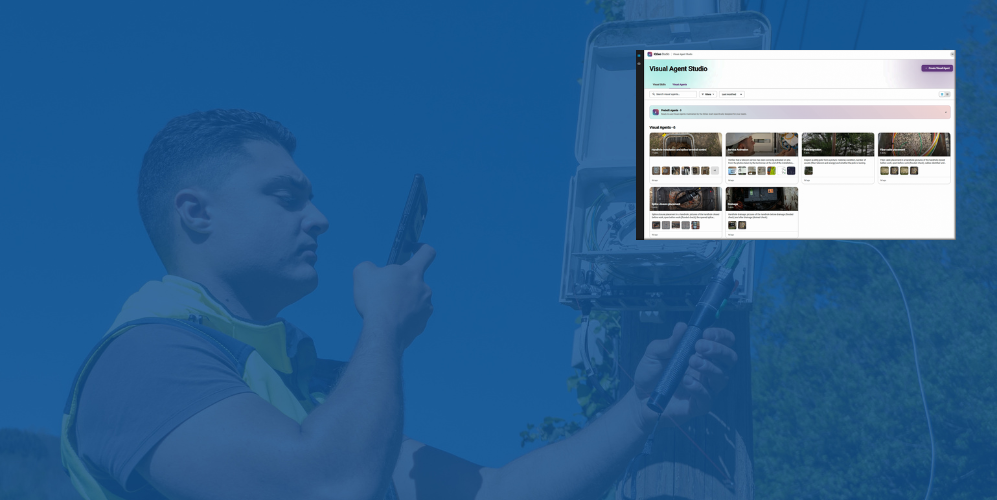
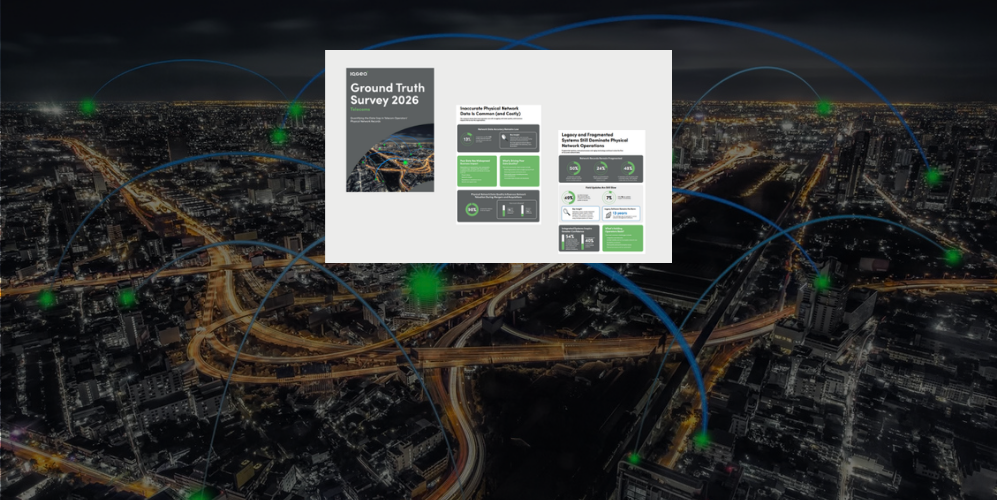
Many telecom operators still rely on time-consuming manual quality assurance and quality control (QA/QC) processes and disconnected software solutions, spreadsheets or paper-based workflows to document their network. Though 90% of operators require engineers to take photos in the field, only 11% are checked and just 10–15% of work is validated.
Without adequate QA/QC oversight, telecom operators can’t guarantee consistent quality, leading to more costly rework and poor customer experiences, which has a major impact on revenue. Current data capture methods leave critical gaps in visibility that only grow as fast-moving telecom leaders expand their networks. IQGeo Visual Agent Studio automates QA/QC in the field and provides operators with a highly detailed, structured and searchable asset record, turning photos taken on site into network intelligence.
What is IQGeo Visual Agent Studio?
IQGeo Visual Agent Studio is a library of fully trained, production-ready visual AI agents that analyze field photos, extract structured asset data and automatically verify that engineers’ work meets the operator’s quality standards.
Visual Agent Studio eliminates the need for manual review in the back office by providing real-time validation and feedback so that every job is done right the first time. Agents also ensure clean photo records and create robust, searchable asset histories in the system of record (SOR) that teams can use to get insights into network performance. With reliable asset data continuously updated in the SOR and AI agent-driven processes, operators can build towards fully autonomous networks.
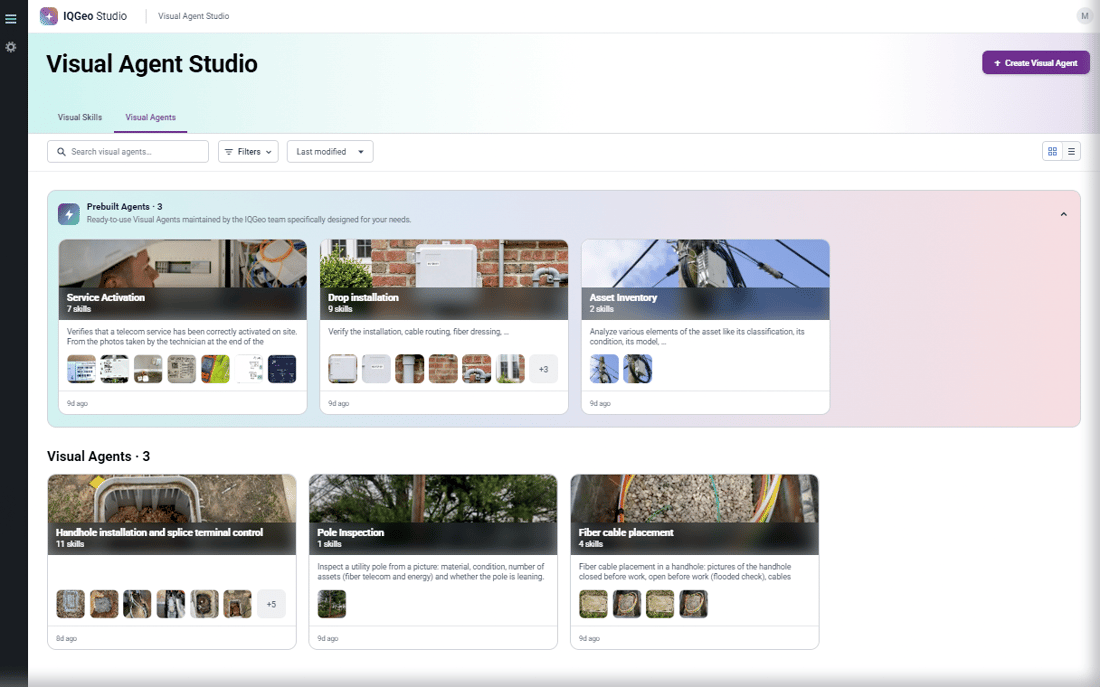
IQGeo currently offers three agents developed specifically to solve telecom operators’ field work validation challenges across the asset lifecycle: Asset Inventory, Drop Installation, and Service Activation.
How Does IQGeo Visual Agent Studio Work?
Visual Agent Studio agents automatically check the photos engineers take to ensure they’re high-quality and that they contain the correct information. If an image doesn’t meet requirements, engineers are prompted to re-take the photo in the moment.
Once the photo is verified, the agent extracts visual data from each image and converts it into structured, detailed, text-based data that’s linked to a work order and loaded into the asset’s record. This eliminates the need for manual review from the back office and automates data organization, giving operators an accurate, living record of asset installation and its condition over time.
Pre-built agents are already trained on millions of photos featuring a wide range of telecom infrastructure including poles, cabinets, fiber splice trays, and aerial and underground equipment. They can be used out-of-the box to handle operators’ most common field and back office use cases immediately, so there’s no need to initiate a long AI development project.
Operators can also configure the agent to handle any business-specific use cases using natural language prompts through an intuitive, conversational interface and example photos, so they don’t have to bring in additional data scientists to further customize the agents’ capabilities.
Visual Agent Studio fits seamlessly into existing field workflows. Operators can integrate agents into the field applications engineers already use via API or through linking them to IQGeo Workflow Manager and IQGeo Network Manager. Engineers can simply take photos and complete the job as usual. Agents run in the background to validate photos, extract data and return real-time feedback through their app interface.
Visual agents also process existing photos from day one, so operators can unlock value from years of unstructured and unsearchable field images without needing to build a bespoke AI solution or generate any new training data. This establishes a trustworthy asset history and provides immediate insight into the quality of the network. Instead of waiting months to complete and roll out a custom AI project, operators get value from their AI investment within days.
How Visual Agent Studio Fits into Telecom Field Workflows
Each agent is purpose-built to serve a specific telecom use case and is ready to deploy in telecom field workflows.
Asset Inventory Agent
Today, operators are sitting on thousands of asset images that they aren’t using to gather network intelligence. Part of the problem is that these photos are siloed away in fragmented systems. As many as 50% of operators use multiple, often disconnected, solutions to manage the network. In many cases, images are never linked to individual asset records and work orders, preventing operators from getting a complete view of their network.
Siloed systems also mean that operators can’t readily search their photo archive. When it’s time to assess the condition of an asset, they have to first find photos before they can (usually manually) analyze them. This process can’t scale across rapidly expanding networks that also contain a growing number of older assets that may no longer be accurate.
Asset Inventory Agent automatically analyzes field photos and identifies data points that align with the operator’s record-keeping requirements. Asset Inventory Agent doesn't just detect numbers and labels using optical character recognition (OCR) to identify the asset. It can also pull out details about the asset’s condition and location, such as vegetation growth, the proximity and materials of surrounding infrastructure (e.g., brick, concrete) and whether the asset shows signs of damage.
Common outputs include:
-
Asset type classification
-
Condition assessment
-
Equipment make and model
-
Visible serial numbers and labels
-
Compliance status
-
Installation or condition anomalies
-
Photo quality flags
Drop Installation Agent
Operators need to complete a high volume of drop installations at speed, but velocity often comes at the cost of quality. Manual close-out reviews can’t catch defects until well after crews have already left the site. Expensive rework slows the installation project and lengthens the service activation timeline.
48% of telecom operators use paper notes and printed maps to document installation work and as-builts in the field, with teams making updates later in the back office. Analogue methods make it difficult for operators to ensure that contractors are adequately documenting the work they’ve completed. Operators can’t validate that the work has been done to their standards, leading to delayed contractor payments. They’re also left without auditable proof of work to add to the network SOR.
Drop Installation Agent can be integrated into contractor telecom field workflows to enforce operators’ quality standards in real time while the engineers are on site. It automatically analyzes the photos engineers take and determines whether the work has been completed correctly. If the agent detects an error, it notifies the engineer who must make the fix and resubmit a new image for validation before moving onto the next step of their workflow.
Every job is checked against the same criteria, so no matter who is working on the network, operators can keep quality consistent at scale.
Drop Installation Agent is ready to validate almost every aspect of an installation out of the box, including:
-
Installation type and method
-
Cable routing and management
-
Conduit presence
-
Ground wire connection
-
Trench depth
-
Fiber dressing
-
NID mounting and security
-
Site restoration
-
Overall workmanship quality
Drop Installation Agent generates an automatic proof of work, capturing timestamped evidence of work completed and linking that data back to the asset record and work order. The agent writes asset data directly to IQGeo Network Manager, so there’s no need for manual data entry. It can also link payments to verified work so that contractors receive payment as soon as the job is completed.
Service Activation Agent
Engineers need to move quickly to get each customer connected without disrupting their day. Back-office QA/QC teams can’t manually check all the jobs that come across their desk. There isn’t enough time for engineers to wait for validation from the back office before moving on to their next job. As a result, up to 20% of service activation installs fail because operators can’t provide site-by-site quality control and assurance.
Poor-quality installations directly impact the customer, increasing the likelihood that they’ll churn. They also trigger expensive truck rolls and delay time-to-revenue as operators race to ramp up profitability. Service activation is the highest-volume phase of network delivery and the cost of individual errors quickly compounds across hundreds of new locations, cutting into the bottom line when it matters most.
Operators also have no visibility into whether contractors adhere to their standards, leaving them with little control over the end customer experience. As with drop installation, manual proof-of-work processes make it hard to validate contractor work at closeout, adding complexity to the payment process that slows the back office down and can lead to frustrating disputes.
Service Activation Agent reduces the risk of installation errors in the moment so that engineers can work more efficiently while ensuring that customers are properly connected every time. The agent analyzes photos engineers take at checkpoints throughout their workflow to verify that they are completing the installation correctly. It then provides real-time feedback to the technician so they can make changes as they go.
Service Activation Agent also makes the technician’s job easier. Rather than spending time filling out work order fields before heading to the next site, the agent does it automatically using data pulled from the photos.
The agent captures and records installation data, including:
-
ONT and gateway serial numbers
-
MAC addresses
-
Equipment make and model
-
Installation compliance status
Service Activation Agent ensures that every job is done right the first time while keeping incoming asset data clean. Like Asset Inventory Agent and Drop Installation Agent, Service Activation Agent creates a structured, auditable asset record that’s tied to a work order and immediately written to the SOR. This gives operators a clear picture of service activation quality and a deeper understanding of the customer experience, enabling them to make improvements that enhance efficiency without compromising the customer relationship.
Unlock Intelligence in Your Field Photos with IQGeo Visual Agent Studio
Get total visibility into network performance, enforce quality standards across installations, and ensure right-first-time work at every site. With IQGeo Visual Agent Studio, operators can embed data capture and verification into crews’ everyday workflows, enabling them to validate 100% of field work and build reliable, living asset records that lay the foundation for autonomous networks as they scale.