<img alt="" src="https://secure.smart-company-365.com/266006.png" style="display:none;">
IQGeo_Logo_w_tag_2024_on_white


PRODUCT SUPPORT AGREEMENT

The additional terms and conditions set forth in this Product Support Agreement, together with the general terms and conditions of the Subscription Agreement to which this Support Agreement is added as a Schedule (“the Terms”), shall govern the provision of Support for IQGeo Products, as detailed in a jointly agreed Order Form. Capitalized terms shall have the same meaning as defined in the Terms or within this Schedule.

1. IQGeo Product Support Services

IQGeo Product Support provides Customers a help desk to answer technical questions about IQGeo Products, track incidents and diagnostic services for any Standard IQGeo Product. As part of its Product Support activities, IQGeo shall:

  • Accept Support Incidents reported by designated Customer personnel;
  • Receive, log, and track incidents (Ticketing System) and provide incident status to designated contacts;
  • Publication of support incident status through the IQGeo Support Portal;
  • Provide basic guidance in using an IQGeo Product;
  • Provide incident analysis and resolution;
  • Advise on Customer-specific environmental factors, like product configuration and access configuration;
  • Provide remote troubleshooting, if access to the Customer system is available;
  • Identify and report Product Defects to IQGeo Engineering.


A Support Incident means an incident that has been verified by the Customer to be a problem within the IQGeo Platform or an IQGeo product, as well as vetted through the Designated Customer Personnel. Designated Customer Personnel means a limited number of Customer employees who have received sufficient training to be proficient with the software. Custom Software means the software elements that are specifically designed and developed to meet the unique requirements of the Customer, and are not generally available to other users or organizations. Standard Product means such software developed and marketed by IQGeo that is not Third-Party software and does not contain Custom Software elements. A Support Incident means a reported Incident related to the Standard Product that can be categorized under Severity 1, Severity 2 or Severity 3 or Severity 4 in the Severity Level Tabel below in Section 5 (Incident Management).

Support Service Terms:

  • Customers must renew subscription and, where applicable, Maintenance and Support agreements annually without lapsing in order to receive Support services;
  • IQGeo Support Help desk hours of operation are limited to the following based on the Customer’s respective location (ignoring daylight savings time) (Business Hours):

    • Americas: 08:00 MT to 17:00 MT (15:00 UTC to 24:00 UTC);
    • Europe: 08:00 GMT to 17:00 GMT (08:00 UTC to 17:00 UTC);
    • Asia: 08:00 MYT to 17:00 MYT (00:00 UTC to 09:00 UTC).

  • Response times to reported incidents are described in Section 5 (Incident Management) below;
  • Support is provided remotely from an IQGeo location and does not include onsite services unless otherwise contracted separately.


2. Product Maintenance

IQGeo makes Product Releases generally available from time to time to all customers who have an active subscription or, where applicable, an active Maintenance and Support contract for such Product. A Product Release is supported on a defined set of operating systems as described in the documentation for that release, and customers may have to update operating systems and other dependent software in order to use such release. A product update (via a container image) is a product correction delivered as an update to a previous Product Release for customer expediency.

IQGeo SaaS customers benefit from product upgrades and updates being deployed by IQGeo. Customers who elect to host their own deployments (or for whom IQGeo provides dedicated hosting) should aim to install product updates at the earliest possible opportunity, to ensure that they deploy security and functional fixes as soon as possible.

  • IQGeo will use commercially reasonable efforts to provide Maintenance Services for any particular product version for 24 months from its release date.
  • Product Releases may require changes to the underlying database schema. If so, customers may need to upgrade via multiple steps if moving between non-sequential releases. Please consult IQGeo Support if you are uncertain of what steps are required.

For SaaS customers, upgrades and updates of your environments is included in your subscription. For customers who host their own deployments (or use IQGeo dedicated hosting) work to upgrade and/or install updates requires a separate services contract/statement of work


3. Exclusions

The following is excluded from Product Support:

  • User Training is not included in Support Services and can be ordered separately in accordance with Customer needs;
  • Any advice, recommendation or other services provided by IQGeo in respect of any Third-Party Products in the course of providing Support Services are provided at IQGeo's discretion and are provided 'as is' and in good faith;
  • The process of installing and upgrading a Customer Standard Product or Custom Software deployment. On request, and in the absence of a Postproduction Support Agreement, IQGeo will prepare a separate Statement of Work to install and upgrade Custom Software or Standard Product accounting for the additional resources needed.
  • Custom Software developed for the Customer, that is not part of a IQGeo Standard Product, is not covered by Maintenance. Should the Customer desire Support and/or Maintenance for customized software, a separate Postproduction Support Agreement must be executed.


4. Communication Channels and Customer Contacts

IQGeo maintains a professional staff of technical and administrative personnel prepared to help Customers with their Support related questions. It is recommended that Customers also designate specific resources to handle Support related communications with IQGeo.

To ensure optimal service, IQGeo will ask Customers for specific named individuals. All Support related questions should be routed through these individuals, and via the approved communications channels described in this Schedule.

5. Incident Management

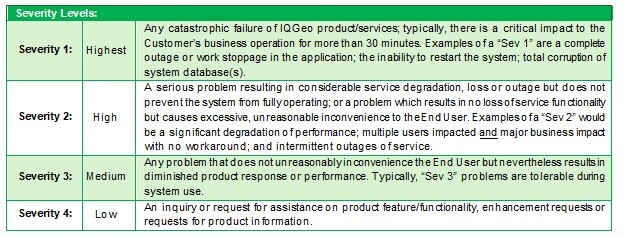
An Incident means anything reported to IQGeo Support Services ranging from a basic question to a system outage. The Severity of an incident is a measure of the impact that the incident has on the business in terms of number of users affected, the amount of data lost or corrupted, and the length of time the Product is unavailable. The Severity Levels are defined in the table below.
IQGeo-Product-Support-Agreement-Table-1

Response. The following guidelines define target Incident response times, within the Business Hours for IQGeo’s Support subscription. Response times may vary based on the specified Support Level outlined in the relevant Order, as detailed here below. IQGeo shall use all reasonable commercial efforts to meet the target response times.

IQGeo-Product-Support-Agreement-Table-2

  • Initial Response Time: The upper limit to when work begins on an Incident. It is measured from the time the customer first contacts customer support to the time the customer receives a first response from a customer support agent.
  • Update Intervals: the upper limit on the frequency by which the customer shall be informed on progress to Neutralization of the Incident.
  • Neutralization: means a permanent fix or a temporary resolution of the reported problem through any combination of the following: fully resolving the reported issue back to pre-failure condition; providing a temporary work around so as to conform with published product specification(s) or documentation; restoring service or operation of the software back to its intended purpose without any material loss of functionality; providing a software patch that restore functionality until a major release is made generally available; or providing instruction(s) on how to avoid the problem in the future.
  • Once a neutralization is identified then Update Intervals become Best Reasonable Effort.

Escalation. In order to ensure that Incidents are handled with due priority, escalation of Incidents can occur when a higher priority incident is reported, or response times are not being met. Escalation is determined by two factors: the priority of the Incident, and whether the proper response has been met for the Incident.

  • Stage 1: Escalation to Support Lead; Provide an action plan to the Customer.
  • Stage 2: Report problem to Account Manager and Operations Manager; Provide an updated action plan to the customer.
    • Functional – Designate a specific resource to handle the problem.
    • Hierarchical – Ensure the proper decision maker is completely informed of all aspects.
  • Stage 3: Escalate to Director of Support; Provide daily feedback to the customer according to the action plan.
    • Functional - Inform IQGeo Engineering and ensure proper resources can be diverted.

The following result in automatic escalations:

  • Severity 1: Any Severity 1 Incident has an automatic escalation to Stage 2, quickly moving to Stage 3 if not resolved in one business day.
  • Severity 2: Any Severity 2 Incident has an automatic escalation to Stage 1, quickly moving to Stage 2 if not resolved in two business days.

Incident Submission. Incidents may be submitted to IQGeo through two alternative channels:

  • Web Portal: Incidents can be submitted and managed through the IQGeo Support Portal via https://support.iqgeo.com. Access to the portal will be distributed when Support Services are contracted or at the time of project go-live.


Last updated 

December 11th, 2025